
The future of marriage introductions: five global trends without the hype
Why search is becoming hybrid, marriage later, and identity and compatibility checks more important than profile volume.
Search is becoming hybrid
It is tempting to reduce global change to ‘everyone moved to apps’. The evidence is more complex: digital search expands choice, while meetings, referrals and trust remain essential. A hybrid model is emerging in which online tools discover candidates and offline interaction tests whether the relationship is real.
The first trend is later marriage. United Nations data show a long-term rise in age at marriage across many regions. Reasons vary: longer education, urban mobility, economic uncertainty and changing life courses. Family-formation services therefore need to serve not only young adults but people over 30, after divorce and with children.
The second trend is search by intention and values rather than a single photograph. Users tire of endless feeds and want earlier clarity about purpose, children, religion, finances and location. An algorithm may narrow the field, but it should not present compatibility as proven science or make the decision for a person.
Five trends without the hype
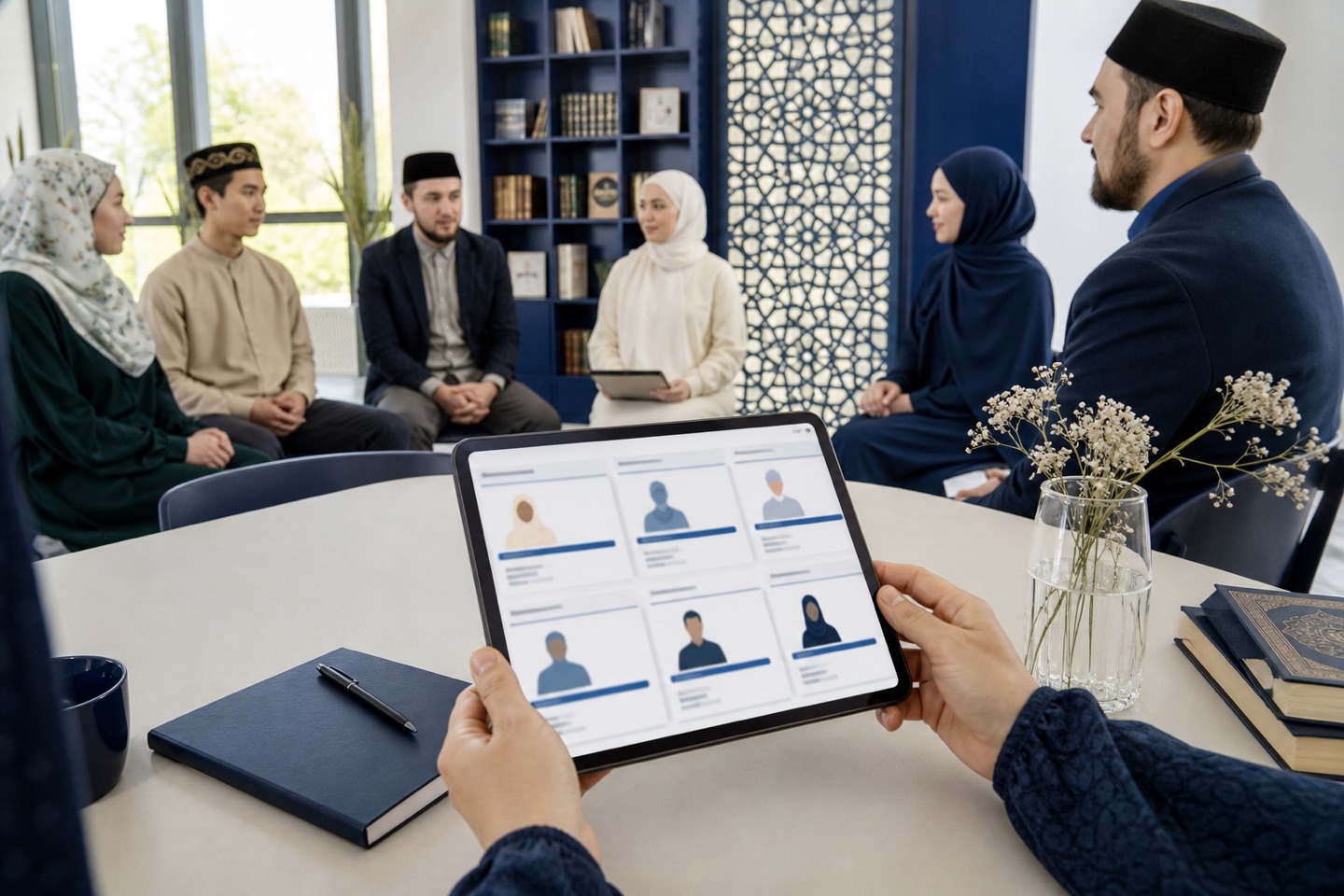
The third trend is the return of a trusted intermediary in digital form: a family referral, community curator, moderated database or an app feature for involving a trusted person. This is legible in cultures where family formation concerns more than two isolated individuals. Family participation must support free choice rather than become control.
The fourth trend is safety by default. Phone or identity checks, video calls, photo visibility controls, reporting, blocking and data deletion are becoming core product functions. Generative AI makes convincing fake profiles and images easier to create, so a polished photograph or short video is not enough to establish trust.
The fifth trend is local community layered over a broad platform. A person may search across a wide area while meeting through a regional event, education programme or trusted community. This matters in Russia and the CIS because of distance, linguistic diversity and uneven Muslim infrastructure.
What a responsible system should protect
Each trend has a downside. More choice can delay commitment; precise filters can create the illusion of a perfect match; greater family involvement can create pressure. A responsible system should care less about time in app and swipe counts and more about substantive conversations, safe meetings and the ability to end contact voluntarily without harassment.
For Mawaddah and Zawajy, the practical implication is to combine technology with guidance: transparent profiles, verifiable intentions, safe communication, optional trusted-person involvement, preparation materials and access to a specialist. This does not promise an ideal spouse. It creates infrastructure for wider discovery, more deliberate choice and earlier discussion of the issues that shape family life.
Forecasts require caution. American or global research indicates direction but does not automatically describe Muslims in Russia, Kazakhstan, Kyrgyzstan or elsewhere in the CIS. Local products need their own research through interviews, privacy-preserving analytics and observation of the pathways that genuinely support safe family decisions.